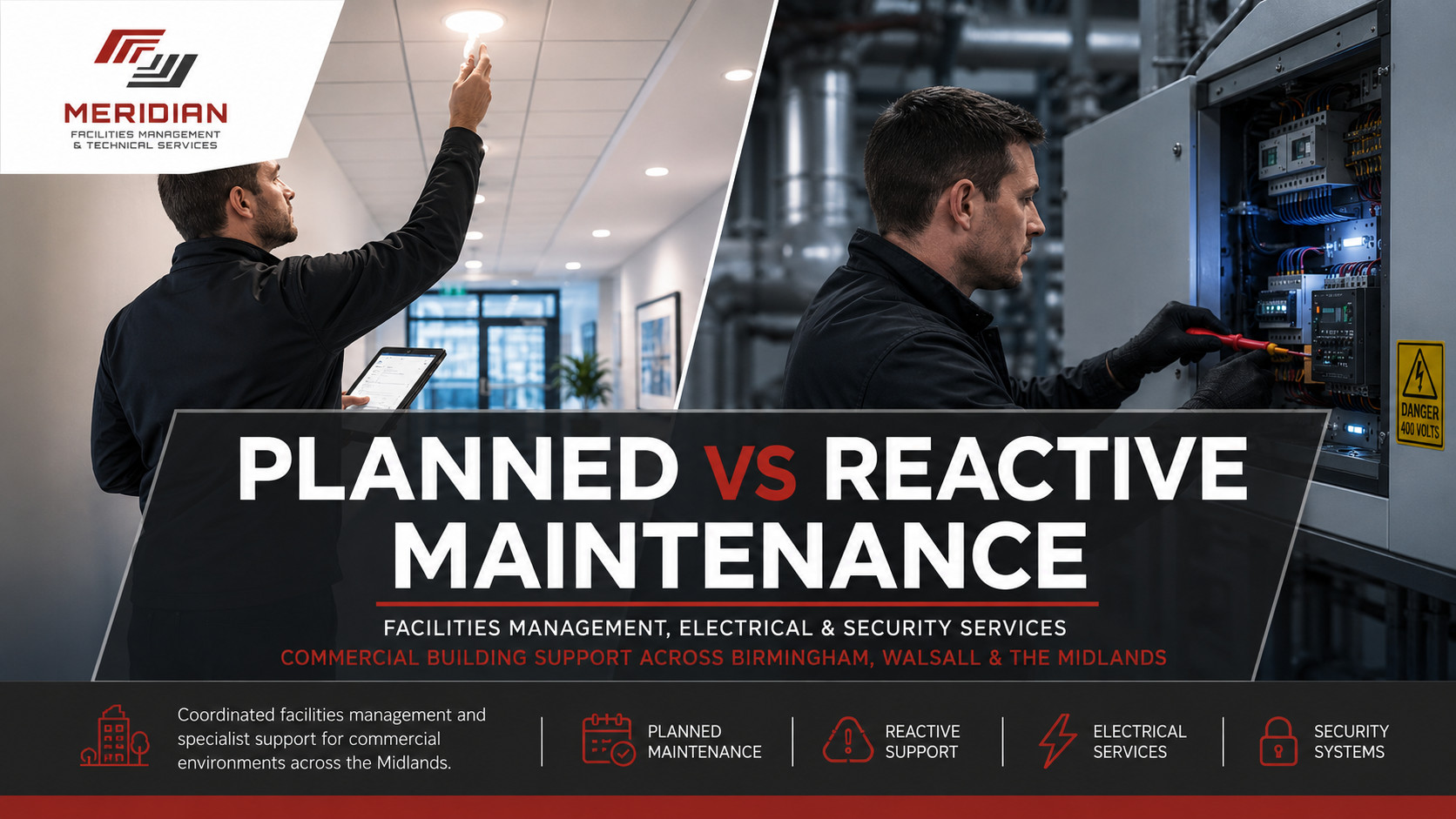
Every commercial building needs regular maintenance, but the way that work is managed can make a big difference to cost, reliability and day-to-day operations.
Some businesses only arrange repairs when something breaks. Others follow a planned maintenance programme that includes regular inspections, servicing and preventative work. In practice, most commercial properties need a combination of both approaches.
Understanding the difference between planned and reactive maintenance can help building owners, facilities managers and operations teams make better decisions about how their premises are looked after.
Meridian Integrated Systems supports commercial and industrial sites across Birmingham, Walsall and the wider Midlands with planned preventative maintenance, reactive support and coordinated facilities management services.
What Is Planned Maintenance?
Planned maintenance is work that is organised and scheduled in advance.
It can include routine inspections, equipment servicing, testing, cleaning, adjustments and the replacement of worn components. The aim is to identify potential issues before they cause a breakdown or begin to affect the operation of the building.
Planned preventative maintenance is often shortened to PPM. A PPM schedule is usually created around the systems installed within a property, the way the site is used and any servicing or inspection requirements that need to be met.
Typical planned maintenance tasks may include:
- Electrical inspections and testing
- Emergency lighting checks
- Security system servicing
- Access control maintenance
- Lighting inspections
- General building repairs
- Data and communications checks
- Review of maintenance records
The exact schedule will vary from one site to another. A large industrial building may require more frequent checks than a small office, while sites that operate for long hours may need maintenance arranged around shift patterns and production schedules.
What Is Reactive Maintenance?
Reactive maintenance takes place after a problem has already appeared.
This could be a failed light fitting, an electrical fault, a damaged door, a security system issue or another building defect that requires attention. The purpose of reactive maintenance is to restore the affected system or area as quickly as possible.
Some reactive work is unavoidable. Even a well-maintained building can experience unexpected faults or damage.
However, businesses that rely too heavily on reactive maintenance can find themselves dealing with repeated call-outs, higher repair costs and unnecessary disruption.
Common reactive maintenance issues include:
- Loss of power to part of a building
- Faulty lighting
- Access control failures
- Problems with CCTV or security equipment
- Damaged fixtures and fittings
- Building fabric repairs
- Unexpected system faults
Reactive support is an important part of facilities management, but it should not replace a structured maintenance plan.
The Main Difference Between Planned and Reactive Maintenance
The main difference is when the work takes place.
Planned maintenance is carried out before a failure occurs. Reactive maintenance begins once an issue has already caused a problem.
With planned maintenance, businesses have more control over when work is completed. Jobs can be scheduled during quiet periods, outside normal operating hours or at a time that causes the least disruption.
Reactive repairs are often more urgent. The business may have little choice over when the work needs to happen, particularly if the problem affects safety, security or essential building systems.
This can lead to delays, unexpected costs and disruption to staff, customers or normal operations.
The Benefits of Planned Preventative Maintenance
A good PPM programme gives businesses a clearer view of the condition of their building and its systems.
Regular inspections and servicing can identify wear, damage or poor performance before it becomes a major fault. This gives the business time to plan the correct repair or replacement.
Planned maintenance can help businesses:
- Reduce unexpected breakdowns
- Improve the reliability of building systems
- Extend the working life of equipment
- Plan maintenance budgets more accurately
- Arrange work at convenient times
- Keep maintenance records organised
- Support workplace safety and compliance
- Reduce disruption to normal operations
For busy commercial sites in Birmingham and Walsall, this level of control can be valuable. Offices, warehouses, industrial units and multi-site businesses often depend on electrical, security and communications systems throughout the working day.
Even a small fault can create wider problems when these systems are not maintained properly.
The Role of Reactive Maintenance
Although planned maintenance has many benefits, reactive support still has an important role.
Unexpected issues can happen for reasons that cannot always be predicted. Equipment can be damaged, components may fail without warning and faults can develop between scheduled inspections.
A dependable reactive maintenance service gives businesses access to support when these problems occur.
Reactive work is particularly important when an issue affects:
- Staff or visitor safety
- Building security
- Electrical supplies
- Access to the premises
- Essential equipment
- Daily business operations
The key is to use reactive maintenance as part of a wider facilities management strategy rather than relying on it as the only form of building maintenance.
The Risks of Relying Only on Reactive Repairs
Waiting until something breaks may appear to save money in the short term. If a system is still working, it can be tempting to leave it alone.
However, this approach can create larger costs over time.
A small fault may cause damage to other components. Equipment that could have been repaired during a routine visit may eventually require complete replacement. The business may also need to pay for urgent attendance or temporary solutions.
Relying only on reactive maintenance can lead to:
- Frequent emergency call-outs
- Higher repair and replacement costs
- Increased downtime
- Poorer system performance
- Unplanned disruption
- Shorter equipment lifespans
- Difficulty planning maintenance budgets
- Repeated faults that are never fully resolved
It can also make compliance and record keeping more difficult. Without a clear schedule, important inspections or servicing dates may be missed.
How Planned and Reactive Maintenance Work Together
The most effective approach is usually a combination of planned and reactive maintenance.
Planned maintenance helps prevent avoidable failures and keeps important systems in good condition. Reactive support provides a response when something unexpected happens.
When both services are managed by the same facilities management provider, communication can be much simpler.
The team completing reactive repairs can record what went wrong, identify repeat issues and recommend changes to the planned maintenance programme. This helps the maintenance strategy develop around the real needs of the building.
For example, if the same electrical component requires several call-outs, it may be more cost-effective to replace it or inspect similar equipment elsewhere on the site.
This joined-up approach helps businesses move away from repeatedly treating the symptoms of a problem.
Choosing the Right Maintenance Schedule
There is no single maintenance schedule that suits every commercial building.
The right approach will depend on several factors, including:
- The size and age of the property
- The type of systems installed
- How many people use the building
- The hours the site operates
- The condition of existing equipment
- The effect a breakdown would have
- Manufacturer servicing recommendations
- Relevant testing and inspection requirements
A facilities management provider should take the time to understand the building before recommending a maintenance plan.
The schedule should also be reviewed over time. If a system develops repeated faults or the way the building is used changes, the level of maintenance may need to be adjusted.
Using Maintenance Records to Improve Reliability
Good record keeping is an important part of both planned and reactive maintenance.
Records help businesses see when equipment was last inspected, what repairs have been completed and whether the same problems are happening repeatedly.
Useful maintenance records may include:
- Inspection dates
- Service reports
- Fault descriptions
- Repairs and remedial work
- Parts that have been replaced
- Recommended future work
- Upcoming testing or servicing dates
This information supports better decision-making. It can help businesses identify equipment that is becoming unreliable and prepare for future repairs or replacement.
It also gives building managers a clearer overview of maintenance activity across the site.
Reducing Downtime in Commercial Buildings
Downtime can be costly for any business.
An electrical fault may stop staff from using an area of the building. A failed access control system could prevent people from entering. Security equipment problems may leave parts of the premises unprotected.
Planned maintenance reduces the risk of these issues appearing without warning.
When work is arranged in advance, businesses can prepare for it. Staff can be informed, affected areas can be managed and tasks can be completed at a suitable time.
Reactive support then provides a clear route for dealing with the issues that could not have been anticipated.
Together, these services help create a more reliable commercial environment.
Planned and Reactive Maintenance in Birmingham and Walsall
Commercial and industrial buildings across Birmingham and Walsall have a wide range of maintenance needs.
From city centre offices and retail spaces to warehouses, workshops and industrial sites, every property depends on reliable building systems.
Meridian Integrated Systems provides structured facilities management support across the region, including:
- Planned preventative maintenance
- Reactive support
- Electrical installation and maintenance
- Security systems
- Data and communications
- Building maintenance
- Statutory testing and inspections
- Contractor coordination
Our technical background allows us to understand how different building systems work together. This helps us provide practical support based on the needs of each site.
Which Approach Is Right for Your Business?
Planned maintenance should form the foundation of a commercial building maintenance strategy.
It gives businesses more control, supports long-term reliability and reduces the chance of avoidable breakdowns. Reactive maintenance should then provide support when urgent or unexpected issues arise.
Using both approaches creates a more complete service.
Businesses benefit from regular attention and early fault detection, while still having access to help when something goes wrong.
Speak to Meridian Integrated Systems
A commercial building should not have to experience a major failure before maintenance becomes a priority.
A structured combination of planned and reactive support can help reduce disruption, protect building assets and keep essential systems working reliably.
Meridian Integrated Systems supports commercial and industrial properties across Birmingham, Walsall and the wider Midlands with dependable facilities management and specialist technical services.
Contact our team to discuss a maintenance programme for your commercial premises.
Do you need help from our experts?
Give us a call today to get expert advice and support from our experienced team.